Saturday, October 22, 2011

KEITH HARRELL: 10 WAYS TO TURN YOUR ATTITUDE INTO ACTION

Step I: Understand the Power of Attitude
Your attitude is a powerful tool for positive action. It’s inherently interwoven into everything you do. It’s your most priceless possession. The good news is, you don’t have to buy it. But you do have to develop it.

Step 2: Choose to Take Charge of Your Life
Transform your attitude into action, you must accept responsibility for what goes on inside your mind by monitoring your internal dialogue.

Step 3: Identify Through. Self-Awareness the Attitudes That Hold You Back or Propel Your Forward
Practicing self-awareness, you will learn the three types of bad attitudes. You will discover how to assess your present-day attitude by identifying the things that may be holding you back and to find the attitude needed to propel you forward.

Step 4: Reframe Your Bad Attitude
An attitude of anger can be transformed into an attitude of gratitude and forgiveness by shifting your perspective.

Step 5: Find Your Purpose and Passion
Once you’ve determined what has been holding you back, it’s time to look ahead and analyze where you want to go. Understanding the importance of living your life with purpose and passion—having a personal vision—is critical to achieving success.

Step 6: Be Pre-Active
Even with a positive attitude, purpose, and passion, life is never without challenges, disappointments, setbacks, and problems. By developing a pre-active approach to life, you will become better prepared to handle the hazards you face in life.

Step 7: Discover How to Motivate Yourself
E keys to self-motivation by making use of the Attitude Tool Kit: affirmations, visualization, attitude talk, positive greetings, enthusiasm, spiritual empowerment, humor, and exercise.

Step 8: Build Supportive Relationships
Nobody makes it alone in this world. We all need supportive relationships to get through challenging times.

Step 9: See Change as an Opportunity
One of the greatest challenges to a positive attitude is change, whether it’s a change of jobs, a change in a relationships or a change in your economic status.

Step l0: Leave a Lasting Legacy
Sometimes we forget that the greatest thing we can do to build a healthy attitude is to get involved in something greater than ourselves.

From "Attitude Is Everything" by Keith Harrell

Friday, October 21, 2011

EMBRACE TECHNOLOGY

"If the competition has laptop computers
and you're still using yellow legal pads, it
won't matter how long and hard you work
 -- they're going to pass you by."

Thursday, October 20, 2011

BRIAN TRACH: 7 DISCIPLINES FOR HIGH PERFORMANCE

Goal Setting
Every morning, take 3 to 5 minutes to write out your top goals in the present tense. Get a spiral notebook for this purpose. By writing out your 10 goals at the beginning of each day, you will program them deep into your subconscious mind.

This daily goal writing will activate your mental powers. It will stimulate your mind and make you more alert. Throughout the day, you will see opportunities and possibilities to move more rapidly toward your goals.

Planning and Organizing
Take a few minutes, preferably the night before, to plan out every activity of the coming day. Always work from a list. Always think on paper. This is one of the most powerful and important disciplines of all for high performance.

Priority Setting
The essence of all time management, personal management, and life management is contained in your ability to set proper priorities and use of your time. This is essential for high performance.

Concentration on your Highest-Value Activities
Your ability to work single-mindedly on your most important task will contribute as much to your success as any other discipline you can develop.

Exercise and Proper Nutrition
Your health is more important than anything else. By disciplining yourself to exercise regularly and to eat carefully, you will promote the highest possible levels of health and fitness throughout your life.

Learning and Growth
Your mind is like a muscle. If you don’t use it, you lose it. Continuous learning is the minimum requirement for success in any field.

Time for Important People in your Life
Relationships are everything. Be sure that in climbing the ladder of success, you do not find it leaning against the wrong building. Make time for your relationships every day, no matter how busy you get.

www.BRIANTRACY.com


SABAN'S PROCESS ORIENTED GOALS

The following is an article written by Carl Dubois of The Advocate.  It is a tremdnous look into one of the most powerful parts of the Nick Saban philosophy -- "being process driven" as opposed to being "result oriented."  Carl does a great job of painting the way the 2003 National Championship Team viewed goal development.  We gave this to our team yesterday:
They called them "Tiger Goals 2003." They posted them on the wall of the corridor leading from the locker room to Tiger Stadium.

They followed them and won a national championship.

LSU seniors and other leaders met before the season to compile a list of goals. That list matched the personality of coach Nick Saban, as it was process-oriented rather than result-oriented, but Saban said the players chose their 2003 goals on their own.

Half a year later, the Tigers celebrated a No. 1 ranking in the USA Today/ESPN coaches poll and a BCS national championship after a 21-14 victory over Oklahoma in the 2004 Nokia Sugar Bowl. Saban said the team's determination to live up to their goals helped them achieve their success this season.

"We started out this year saying that we might not have the leadership that we need, and we challenged everybody to be responsible for their own self-determination," Saban said. "I have never seen a group of players that were able to do that and become so close and unified in the way they did it."

LSU senior offensive tackle Rodney Reed said the Tigers wanted to set goals that were realistic. The 2002 team authored a list that was topped by the most result-oriented goal in college football: Win a national championship.

The team finished 8-5, losing four of its last six games.

A year later, the 2003 team refrained from specific outcomes on its wish list, and in so doing, created a foundation for the kind of success LSU hadn't seen since 1958. The Tigers won a national championship without expressly setting out to do so.

It was a decidedly Saban-like approach, and the proof is in the payoff.

Here, in ascending order, are the goals on the "Tiger Goals 2003" pyramid, with some reflections from Saban and his players about how the team followed them.
 
Team
Saban said often that the Tigers had the best chemistry of any team he's been associated with in 30 years of coaching. Players said it took many forms, and it started when they bonded during demanding offseason strength and conditioning workouts.

LSU defensive end Marcus Spears, whose 20-yard interception return for a touchdown proved to be the difference in the Sugar Bowl, used words that evoked references to the first goal on the list -- when he could have been talking about what a great play he made.

"I think the big key was it was a total team effort on the defensive side of the wall," Spears said, using a cliché but saying it with sincerity and conviction. "We didn't have one player stepping out from each other."

Not even senior tackle Chad Lavalais, a consensus All-America, tried to put himself above his teammates, Spears said.

"Even though Chad is a great player, he believed in everybody around him," Spears said, "and he believed that when he wasn't there, somebody else was going to be there (to make a play)."

Saban said the Tigers were an inclusive group, not a divisive one. Everyone on the team accepted everyone else, he said, like he'd never seen before.

"It was because of the older guys' willingness to accept the younger guys to be a part of the team," Saban said, "that made a big difference on this team."

Together Everyone Achieves More
If this goal sounds similar to the first one, that's because it is. It's instructive to note the Tigers put a lot of emphasis on goals that valued teamwork.

Freshman running back Justin Vincent said he spent a lot of time around the seniors, who earned Saban's praise by choosing not to follow sports convention and ostracize, haze or alienate newcomers. Saban said there was no class system on the team, a rarity for a large group of such diverse people.

Vincent, the Most Outstanding Player of the Sugar Bowl, said senior offensive guard Stephen Peterman typified the Tigers' belief in teamwork this season.

"He's like a great mentor," Vincent said of Peterman. "There's nothing more you could ask for in a teammate or a person. He showed me the ropes, told me to take things in stride."

LSU's offense didn't score a second-half point Sunday, but Reed was grateful the defense came to the rescue with a smothering performance against an explosive Oklahoma offense.
 
"All of our credit goes to our defense," Reed said. "Our defense played just lights-out and just put us in so many opportunities to be successful. I guess the offense did just enough. It was a team win, and I'm just proud as heck of everybody who was involved in it."

Trust
Saban said the players showed their faith in each other during the most trying moments of the championship game, such as when Oklahoma blocked a punt to set up a 2-yard touchdown drive that tied the game at 7-7.

"They believed in themselves, they believed in each other, and this game was no different than a lot of other games we played this year," Saban said.

Players throughout the season talked about trusting the system, trusting that if they did the work, they would see it bear fruit. The season-ending eight-game winning streak and BCS national championship proved it in a big way.

The Tigers gave credit to Saban and his staff. Implicit in their remarks was the notion they trusted the coaches because they saw how hard the coaches worked.

"I think the chancellor of LSU is happy that the coaches don't work on an hourly salary," quarterback Matt Mauck said. "That would be a lot of money. They put in a lot of effort.

"The knowledge that they pass along to us is the reason we have success."

Dominate Your Opponent Every Day
The idea is to outwork the other guy, to do something each day to get the edge, to run that extra sprint or do that extra repetition in the weight room in the hope of seeing it pay off down the road.

Before the championship game, Peterman said he's a believer in that approach, a Saban staple.

"One thing that definitely rubs off on me is his idea to dominate and create a nightmare for the other team," Peterman said. "I try to go out there every time and dominate the guy I'm going to play against. The way he preaches that all the time, it rubs off on you."

LSU uses a weightlifting program, inspired by Gayle Hatch and adapted for the Tigers by their strength coach Tommy Moffitt, that helped Tennessee and Miami win national championships four years into the system. Saban added an offseason running program featuring a brutal stretch of 26 sprints of 110 yards.
 
Lavalais said the strength and conditioning program is one aspect of trying to dominate your opponent every day.

"I'm not saying it's impossible to do," Lavalais said of the workouts. "You can do it, but they make it so hard to where the games come easy. There's no game I've played in that's as hard as the 110s that we run in the offseason.

"That's a testament to the coaching staff, the strength coaches. If you go out there with the mindset that you want to get better and try to kill all these sprints and the weight training we do, when it comes time for the game, it's a breeze."

Spears said the Tigers buy into the system, and it works.

Lavalais said players on other teams tell him they don't do nearly as much as the Tigers in the offseason. He smiled when he said it, then laughed, knowing it is probably a big difference-maker.

Discipline, Focus, Execution
Saban's ability to focus is almost legendary at LSU. The discipline required in long hours of work is hard for most people to sustain. Execution, he believes, is a product of repeatedly doing the work.

LSU Chancellor Mark Emmert and Athletic Director Skip Bertman said they see the Tigers as an extension of Saban's personality, and in the areas of discipline, focus and execution, they both said they've not been disappointed by the team.

Saban's team had precious few discipline problems and no embarrassing off-field incidents that put the program in a bad light. As for focus, Emmert said it starts at the top, with perhaps the best example he's ever seen.

"He is incredibly focused on the task at hand," Emmert said of Saban. "Many people work very hard. Many people work as hard as Nick does, but to stay as focused on the detail of what needs to occur and to have a systematic game plan for achieving that success is, I think, a really distinct characteristic that he has."

Finish Plays
The underlying message here is also to finish games. LSU saw a big opportunity slip away at the end of 2002 when Arkansas rallied in the final minute of the regular season for a touchdown and a 21-20 victory over the Tigers. That sent the Razorbacks, not LSU, to Atlanta for the Southeastern Conference Championship Game.

LSU was not without its mistakes this season. Replay the games on videotape and you'll find flaws. You'll also see defenders closing holes, wrapping up on a tackle and bringing the ballcarrier down, offensive linemen staying on their blocks and heading downfield to deliver another.
 
Wide receivers did that too.

Finishing plays and finishing games with the right competitive spirit, Saban said, is how you finish a season the right way. Few will argue with the results of an LSU team that didn't lose in eight games after Oct. 11.

Positively Affect Someone Every Day
Saban said veteran cornerback Randall Gay roomed with freshman Daniel Francis early and helped him with his struggles to learn how to play defensive back in Saban's system.

"That happened on every level of our team," Saban said. "Every older guy helped every younger guy like I've never seen."

Be A Champion
Saban couldn't have scripted it any better. The Tigers didn't wear on their sleeves their desire to win a championship. They instead were careful to emphasize the steps needed to get there.

In so doing, they won three championships: the SEC Western Division, the SEC overall title, and the BCS national championship.

Today they can walk with their heads held high as champions because for the last six months, and more, they tried every day to carry themselves as champions.

"That's the thing," Reed said in August. "You can set goals that anybody can accomplish every day, whether it's in the classroom or on the football field. If you do those things every day, follow the goals and pay attention to the details, good things will happen to you."

He was right.

ATTITUDES OF SUCCESSFUL LEARNERS

Big thanks to J.P. Clark of the UCF Men's Basketball program for passing on these thoughts from Chris Widener:

We can choose our attitudes about anything, including learning and education. That's right. We get to choose what our attitudes are. Here is the definition of attitude: "The feeling or opinion about something or someone, or a way of behaving that follows from this." We choose our opinion about people and situations. We choose the way we will behave in relation to other people and circumstances. We choose what we believe about learning. We choose it. Learning doesn't have to be bad. It doesn't have to be anything but what we want it to be. We have the option. We can have tremendously optimistic attitudes about learning - attitudes that will help us grow in ways we have never achieved before! The choice of a right attitude will significantly determine new circumstances.

Choosing to have the right attitude will change the world around you. This isn't any sort of magic; it is just how the world works. Now, don't get me wrong. It won't cure everything and turn your world into a virtual Shangri-La, but it will significantly improve the world you live in. For example, let's say that everyday you go into work and you gripe about life and work from the moment you get there until the moment you leave. Will others want to be around you? Will others ask your opinion? Will others like you? Will others ask you to join them for lunch? Probably not! But what if you come to work every day and you are the positive optimist of the crowd? Will everybody love you? No, but significantly more people will than if you are the office pessimist! Your choice of attitude will determine what kind of circumstances you get!

The same is true with learning. What we feel about learning, and what we believe about it will determine the outcomes of our learning. And the outcomes of our learning will determine the outcome of our lives. Ultimately, our attitude is a choice. Nobody else can force you to have a bad attitude. Nobody else can force you to have a good attitude. It is simply a choice we each make.

Where are you with your attitude about learning? Is it positive? Take some time to give it some serious thought. Then, no matter where you find yourself, decide to take your attitude to the next level! If you have a really bad attitude, decide to take it up a couple of levels!

So, if our attitudes determine to a great degree what kind of life we have, shouldn't we focus on the best attitudes to have and then make them ours? Absolutely! If we want to soar with the eagles in this life, and if there are attitudes that will make us soar, shouldn't we pursue them with all our hearts? By all means! So here we go!

Attitudes of Successful Learners

1. "I can."
This is the most basic of all attitudes. We simply must choose to believe that we can learn. In our house we are not allowed to say, "I can't." We can say, "I'll try," or "I tried and failed," but not "I can't." Telling yourself that you can't will in effect make it so. But telling yourself that you can, will in effect enable you to learn much more. Even if you actually only achieve 50% of what you tell yourself, you will achieve at least that much more than if you told yourself you couldn't. So many people were told at a young age that they couldn't learn. Many others were allowed to engage in that kind of negative self talk (tell themselves, "I can't learn", "I don't understand", I'll never get this", etc.) and their parents and teachers didn't intervene. This enabled them to develop the "I can't" attitudes that become self-fulfilling prophecies. I actually have a standard way of going about getting myself off of the starting block. I simply say if somebody else has achieved great learning heights, then I can too. I have to be smarter than at least one of those who has already done it. I have to be able to work harder than at least one other. There has to be at least one other person who has come from more difficult circumstances than me. And if they can do it then certainly, "I can!"

2. "This is a long-term approach."
Learning isn't something that happens overnight. Yes, you can learn individual facts, but the real growth comes when you see your learning build on itself and compound for years, when your knowledge meets up with your experience. When we take the attitude that it all has to happen immediately, we hurt ourselves in the long run because the fact is that it takes time to learn (even though we can accelerate it). If we expect it to happen immediately and it doesn't, then we can get frustrated and stop learning altogether. Instead, we need to take a long-term view just as we do in financial matters, weight management, leadership, etc. Long-term thinking, including our learning is always the best way to go for success.

3. "Learning is valuable."
Some people have a "learning schmearning - who needs learning" attitude. They think that learning is overrated. I hate to tell you this, but not only was that wrong 5000, 500 and 50 years ago, it is especially wrong today. We live in the information age. We must gain knowledge and the ability to apply that knowledge if we are going to be successful. We must tell ourselves and cultivate the attitude that learning is valuable and that it will affect our lives.

4. "I will make a difference in the lives of those around me."
People who soar are generally people who have the attitude of helping other people. Yes, they may do it for monetary gain, but they are others-focused. They want to change the way people live and experience life for the better. They are difference makers all around. This is the same in what we learn. We learn first for ourselves, but then with the goal of taking what we have learned, and what we make of ourselves, and we then help others to do the same.

I live in a town that is very affluent. Most of the people I know, work with and have as friends are very successful in this world. They have learned a lot about life and how it works. They have learned how to make money and be successful in business. One thing I can say, as almost a universal truth, is that as people, they are not self-consumed but genuinely care about others and will do what they can to help others. This is what I know to be true about the attitudes of the genuinely successful. These are the attitudes of people who are not just successful at getting information into their minds, but in becoming good people because of that information. Learn all that you can, and be sure to keep the attitudes that will make you a successful learner and a successful person!

Wednesday, October 19, 2011

TEAMWORK MAKES THE DREAM WORK

Thoughts from John Maxwell's "Teamwork Makes The Dream Work"

Are you dreaming big enough?

I find that many people are afraid to dream big.

Teams are incredible things. No task is to great, no accomplishment too grand, no dream too far-fetched for a team. It takes teamwork to make the dream work.

The question is not, “Will you participate in something that involves others?” The question is, “Will your involvement with others be successful.”

No problem is insurmountable. With a little courage, teamwork, and determination a person can overcome anything.

“You do not climb a mountain like Everest by trying to race ahead on your own, or by competing with your comrades. You do it slowly and carefully, by unselfish teamwork.”
-Tenzing Norgay (renowned mountain climber)

Teamwork gives you the best opportunity to turn vision into reality.

THE ATHLETE AS A LEARNER

The following comes from "Coaching The Mental Game" by H. A. Dorfman:

The coach should create an environment in which learning is valued.  Not just technique or strategy.  The coach should acquaint himself with the kinds of thinking patterns that help athletes perform more effectively; he should understand the obstacles that inhibit performance; and he should determine which practice patterns work best -- for the individual and for the team.  In other words, he should learn about the mental and physical aspects of the sport and the athlete -- and create an atmosphere in which the athlete is encouraged to learn as well.

Athletes should be encouraged to learn the sport on their own, as well.  The mental game is intellectual as well as psychological.

It's been said that NFL running back Marshall Faulk knows the responsibilities of every player on any play called in the huddle.  He himself says that his learning has helped him to be more effective.  What seems to observes to be astounding spontaneous reactions are, Fault explains, actions based on anticipating (knowing) what will happen in front of him.

Hall of Fame basketball player Larry Bird said he kept a mental record of the moves made by opposing players.  "When you see the same move four or five times, you begin to anticipate what he is going to do," said Bird. 'you cant also get a lot of steals that way."

Bird constantly utilized his learning skills.  His lawyer Bob Woolf said about Bird, "He'll play a golf course once and memorize the location of every tree.  When we work out together, he will measure each step on the court to perfect what type of shot he can take and from what distance."

Tuesday, October 18, 2011

TAKING THE OTHER TEAM OUT OF THEIR OFFENSE WHILE YOU STILL HAVE THE BALL

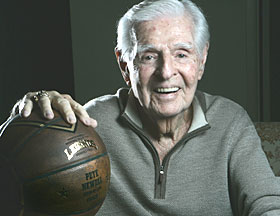
"Offensive thinking very rarely encompasses an immediate adjustment to defense.  We always tried to set up a triangle for rebounding.  The forward on the strong side rebounds at the foul line.  Whoever’s at the post, he rebounds on the strong side of the basket.  The weak-side forward takes the weak side.  We were always looking ahead to that, taking the other team out of their offense while we still had the ball."

-Pete Newell
From "A Good Man: The Pete Newell Story" by Bruce Jenkins


ARE YOU HELPING YOUR PLAYERS PAINT THE RIGHT PICTURE OF YOUR PROGRAM?

We are in an instant media generation.  There was a time where someone came to practice and interviewed you and your players.  Now it can be done via telephone, text, internet -- and by people who may not know the subject matter or care at all about your players and team's public persona.  There was also a time where that interview ran in just the newspaper of the writer that did the interview.  Now such interviews go viral in seconds to masses of media outlets.

What are you doing to help paint the picture of your program in a way that you want it to be received.  The best programs spend time working with their players on the interview process -- everything from the correct answers, to appearance, tone, and even body language.

Here are some great guidelines from Lawrence Frank:

When interviewed during the first 6 weeks, you must mention at least 1 teammate.

When interviewed during the 2nd 6 weeks, you must mention 1 teammate and 1 assistant coach

When interviewed during the 3rd 6 weeks, you must mention someone other than a teammate or an assistant coach.

WHATEVER YOU ARE, BE A GOOD ONE

The following is a passage written by Steve Goodier and passed on to me via Coach Creighton Burns.  When I read it, I thought of players and assistant coaches.  Players must not only accept the roles but take great pride in being the absolutely best at what their coaches are asking them to do.  If the coach is asking you to be primarily a screener -- work to be the best screener on your team, your conference.  If the coach is expecting you to be a defensive stopper -- take great pride in working and developing so that you can be the best stopper in the history of your program. 

If you are an assistant coach, you too will have a role.  If the coach is asking you to be responsible for the team managers, than create an organization of managers that will be second to none.  Maybe you have to represent your head coach in marketing meetings.  If that's the case, take great notes, do your homework so you can contribute in those meetings.  Become an expert in the areas that your coach has assigned to you.  Make a different in your program no matter what your head coach has assigned you to do.

Hope you enjoy this passage:

Pablo Picasso, the great Spanish painter and sculptor, once said this about his ability: 'My mother said to me, if you become a soldier, you'll be a general; if you become a monk, you'll end up as Pope. Instead, I became a painter and wound up as Picasso.' No lack of confidence here!

But he would have agreed with Abraham Lincoln. 'Whatever you are,' said Lincoln, 'be a good one.' He demonstrated the wisdom of that advice with his own life. And in this present age, which often seems to be contented with mediocrity, his words summon a yearning for improvement and growth.

I think it helps to remember that excellence is not a place at which we arrive so much as a way of traveling. To do and be our best is a habit among those who hear and understand Lincoln's admonition. Viennese-born composer Frederick Loewe, whom we remember from his musical scores that include - My Fair Lady, Gigi and Camelot, was not always famous.

He studied piano with the great masters of Europe and achieved huge success as a musician and composer in his early years. But when he immigrated to the United States, he failed as a piano virtuoso. For a while he tried other types of work including prospecting for gold and boxing. But he never gave up his dream and continued to play piano and write music.

During those lean years, he could not always afford to make payments on his piano. One day, bent over the keyboard, he heard nothing but the music that he played with such rare inspiration. When he finished and looked up, he was startled to find that he had an audience - three moving men who were seated on the floor.

They said nothing and made no movement toward the piano. Instead, they dug into their pockets, pooled together enough money for the payment, placed it on the piano and walked out, empty handed. Moved by the beauty of his music, these men recognized excellence and responded to it.

Whatever you are, be a good one. If what you do is worth doing, if you believe that who you are is of value, then you can't afford to be content with mediocrity. When you choose the path of excellence through this life, you will bring to it your best and receive the best it can offer in return. And you will know what it is to be satisfied.