Friday, November 4, 2011

WISDOM FOR THE BUSYCOACH

Stephanie Zonar has been a hero of mine since she wrote "Leader of the Pack," a very touching book about the courageous Kay Yow.  It's a very well written tale of how Coach Yow not only shaped the young women she coached at North Carolina State, but how through her incredible will and determination, she galvanized a nation through women's basketball to fight against breast cancer.  Stephanie has gave portions of the book sales to the Kay Yow Cancer Fund.

Stephanie has a great website (http://lifebeyondsport.com/) with an inspiring blog and has travelled the nation to work with teams.

And now she has a new book out and I love it -- I believe it should be in every coach's library.

"Wisdom for the BusyCoach" -- is just that -- a book filled with short passages on a variety of subjects that can help us with our teams and more importantly -- with ourselves.

Each topic starts with a quote such as:
“Treat people as if they were what they ought to be, and you help them become what they are capable of becoming.”

—Goethe

That is followed with a passage of wisdom:
Sometimes BusyCoaches long for their players to “grow up.” You recruited them because you saw the potential, yet the road to maturity can take so, so long. When you refuse to coddle or make excuses for your athletes, but instead consistently expect them to exhibit character qualities like discipline, commitment and responsibility, you give them tools to achieve greatness. When you hold them accountable for their actions, you create a culture in which maturity will grow.

And then an action question:
Do you respond to your players based on where they are or where you want them to be? How will you help them reach their potential?

Followed by a biblical scripture on that subject:
“Therefore, encourage one another and build each other up as you are already doing.”
—1 Thessalonians 5:11

Another great quality of the book is the index in the back.  Looking for a particular word such as "attitude?"  Go the index and find the pages that have passages regarding "attitude."  In fact, there are over 70 such words including character, persistence, respect, vision, honor, balance and many more.

To appreciate Stephanie's perspective of our profession, you need not go any further than her dedication:

Dedicated to my coaching buddies who model excellence, impart wisdom and teach athletes so much more than x’s and o’s. Thank you for tirelessly investing in the next generation of athletes.

Purchase this book at: http://www.lifebeyondsport.com/mybooks


Thursday, November 3, 2011

CHARACTERISTICS OF GOOD PERIMETER PLAYERS

In developing solid perimeter play, we want to first look for and then develop the following characteristics:

1. SHE MUST HAVE GOOD VISION
Vision is a very encompassing matter. A good perimeter player does more than just see her teammates, she also sees the defense. This particular type of vision allows the good perimeter player to make the proper decisions with the basketball.

2. SHE MUST UNDERSTAND HER STRENGTHS & WEAKNESSES
A good perimeter player knows what she does well and works hard to get in position to take advantage of those skills and fundamentals. Just as important however, is the fact that a good perimeter player knows what her limitations are, her weaknesses, and stays away from them.

3. SHE KNOWS HER TEAMMATES STRENGTHS/WEAKNESSES
This is very difficult for the average perimeter player, and in fact, it is a rare quality usually found in the best perimeter players. That special type of perimeter player knows who the best shooters are on the team and tries to get them the ball when they are open. She knows who the best posters are and feeds them the ball. She knows who has trouble dribbling the ball and doesn’t pass them the ball when it might put them in a dribbling situation.

4. SHE MIXES AGGRESSIVENESS WITH PATIENCE
The good perimeter player knows when to push the ball up and when to hold it up. She knows when to attack the basket and when to reverse the ball. She is prepared to play at whatever speed is necessary for her team to be successful.

5. SHE IS HARD TO GUARD
A good perimeter player is constantly working to get open and at the same time occupy her defender. She understands that she must move with a purpose, because she must never confuse “activity for achievement.”

6. SHE IS STRONG WITH THE BALL
Whether she is dribbling, passing, or holding the ball, she is going to be strong. She is not going to let the defender rush her into a mistake.

7. COMPOSURE—COMPOSURE—COMPOSURE!!!
The best perimeter players never let anything upset them. They don’t let the crowd effect their play; they don’t let the other team effect their play; and they don’t let any breakdowns by their teammates effect their play.

8. SHE MUST BE PHYSICALLY STRONG
We want players that are warriors in the weight room. This is an area that you as a coach must be committed to as much as the players.  Players know what is important to a coaching staff. Working hard in the weight room doesn’t mean that we are interested in huge muscle bound athletes. We are interested in developing upper body strength and explosiveness from the lower body.
 
9. SHE MUST BE AN EXCELLENT CONDITIONED ATHLETE
We expect our perimeter players to be able to outrun the opposing perimeter players down the court for fast break opportunities. And, just as important, we expect our perimeter players to be able to outrun the opposing perimeter players and be in good defensive position in defensive transition. In our motion offense, our perimeter players are constantly moving. We are always telling them, “be hard to guard.” All of this demands a supreme physically conditioned athlete.

10. SHE MUST BE A SMART PLAYER
We expect our perimeter players to be able to “think” the game. Again, because of our motion offense, our perimeter players are expected to constantly decisions while on the floor. When and who to screen, when to pass, when to dribble are just some of the instant decisions we expect them to make. Equally, because we utilize scouting reports, they must know which particular player they are defending and how to defend them.

11. SHE MUST POSSESS A GREAT WORK ETHIC
Obviously, to be a warrior in the weight room, and supreme physically conditioned athlete, and a mentally prepared basketball player, you must first possess a great work ethic. We demand a lot from a our perimeter players and the truly good ones are not afraid to work. To be a top-flight player, a good work ethic is a year round necessity.


Wednesday, November 2, 2011

JON GORDON: TRAITS OF THE BEST

Big thanks to J.P. Clark for passing the following on to us from Jon Gordon:

I had the opportunity this past week to speak to the Atlanta Falcons football team. As I prepared for these talks I thought a lot about what I should say that would benefit them.  After all, I would be talking to people who have reached the pinnacle of their industry.  What could I say that they haven't heard before? I realized that there was nothing new I could say.

They have heard it all. We all have. But what I could do was say it in a way that would inspire them towards positive action. My job was to help the best of the best get even better. This inspired a series of thoughts about what makes someone great in their field of work. I realized the best of the best, whether you are a sales person, teacher, athlete, nurse, entrepreneur, etc, share a number of similar characteristics. Here are three. I hope they inspire you to be your best.

1. The best are always striving to get better.
When I was speaking in Dallas in June, Zig Ziglar was in the front row and to my surprise he was taking notes. Wow, I thought. Here was one of my heroes, eighty years old, and he's still learning and growing. Any speaker could have been up there and Zig would have had his note pad and pen ready. How about you? Are you striving to get better? Are you a life long learner?

2. The best do ordinary things better than everyone else. (Chuck Noll).
There really isn't anything new when it comes to success principles. It's not about doing anything different. It’s about closing the gap that is bigger than the Grand Canyon-the gap between knowing and doing. The best take action. They execute and excel in the small things that create big results. They know that to be the best you must do a hundred simple things 10% better than everyone else.

3. The best stay positive.
Every individual and team faces negativity and challenges but the best rebound with positive energy, resilience, hope and faith. The best stay positive and don't let adversities and obstacles sabotage their individual and team success. The best don't let naysayers and energy vampires keep them from their goal. The best teams get on the bus together, stay positive and move forward with a shared vision,focus and direction.

Tuesday, November 1, 2011

ATTITUDE CAN GIVE YOU A MENTAL EDGE

An attitude can give you the mental edge. It can be the edge over an opponent or a situation.

Emphasize positive experiences
Mentally reliving success helps build confidence that success can be repeated. Remember achievements and use them to create a framework of self-confidence. “I know I can do it because I’ve done it before.”

Commit to the attitude
Only by making a serious and sincere determination to believe in an attitude can it be effective. Attitudes are not about lip service; they demand dedication.

Visualize positive expectations
Sometimes a player needs to stop, shut his eyes, and see himself getting a hit off a tough pitch or pitcher; or a pitcher needs to see himself making a well-executed pitch. The more realistic the visualization, the more impact it will have.

Use self-talk to ingrain attitudes
The player speaks to himself with conviction and emotion until these attitudes become natural, ingrained in the subconscious mind. Understanding the situation and knowing yourself ill dictate the right emotional level for the task, and that level can be controlled by the speed and intensity of self-talk.

Commitment and repetitious affirmations of attitude
As with everything in athletics, attitudes demand practice and regular rededication. A player must reestablish his goals and renew his reasons for providing such intense dedication. The more these thoughts are repeated, the more ingrained they become. Discussing this with a friend or teammate will help affirm the attitude and hold the player accountable.

From "Mental Toughness: Baseball’s Winning Edge" by Karl Kuehl, John Kuehl, and Casey Tefertiller


ON LEADERSHIP


Here are a few random thoughts on leadership from 360 Degree Leadership by John Maxwell:

Leadership is not just one quality, but rather a blend of many qualities; and while no one individual possesses all of the need talents that go into leadership, each man can develop a combination to make him a leader.

Most important of all, to be successful in life demands that a man make a personal commitment to excellence and to victory, even though the ultimate victory can never be completely won. Yet that victory might be pursued and wooed with every fiber of our body, with every bit of our might and all our effort. And each week, there is a new encounter; each day, there is a new challenge.

The leader must always walk the tightrope between the consent he must win and the control he must exert. Despite the need for teamwork and participation, the leader can never close the gap between himself and the group. If he does, he is no longer what he has to be. The leader is a lonely person. He must maintain a certain distance between himself and the members of the group.

You, as a leader, must possess the quality of mental toughness. This is a difficult quality to explain, but in my opinion, this is the most important element in the character of the leader.

You do not need to like someone in order to love them. Love is loyalty. Love is teamwork. Love is respect for the dignity of an individual. Love is charity. The love I speak of is not detraction. A man who belittles another—who is not loyal, who speaks ill of another—is not a leader and does not belong in the top echelons of management.

But remember that the will is the character in action. If we would create something, we must be something. This is character. Character is higher than intellect. Character is the direct result of mental attitude. A man cannot dream himself into character; he must hammer and forge one for himself. He cannot copy someone else’s qualities; he must develop his own character qualities to fit his own personality.

We should remember, too, that there is only one kind of discipline, and that is the perfect discipline. As a leader, you must enforce and maintain that discipline; otherwise, you will fail at your job.

Monday, October 31, 2011

BRIAN TRACY: THE PRACTICE OF DISCIPLINE

Discipline yourself to do what you know you need to do to be the very best in your field. Perhaps the best definition of self discipline is this: "Self discipline is the ability to make yourself do what you should do when you should do it, whether you feel like it or not."

It is easy to do something when you feel like it. It's when you don't feel like it and you force yourself to do it anyway that you move your life and career onto the fast track.

What decisions do you need to make today in order to start moving toward the top of your field? Whatever it is, either to get in or get out, make a decision today and then get started. This single act alone can change the whole direction of your life.

Seven Steps to Success
There is a powerful seven step formula that you can use to set and achieve your goals for the rest of your life. Every single successful person uses this formula or some variation of this formula to achieve vastly more than the average person. And so can you. Here it is:

Decide What You Want
Step number one, decide exactly what it is you want in each part of your life. Become a "meaningful specific" rather than a "wandering generality."

Write it Down
Second, write it down, clearly and in detail. Always think on paper. A goal that is not in writing is not a goal at all. It is merely a wish and it has no energy behind it.

Set A Deadline
Third, set a deadline for your goal. A deadline acts as a "forcing system" in your subconscious mind. It motivates you to do the things necessary to make your goal come true. If it is a big enough goal, set sub-deadlines as well. Don't leave this to chance.

Make A List
Fourth, make a list of everything that you can think of that you are going to have to do to achieve your goal. When you think of new tasks and activities, write them on your list until your list is complete.

Organize Your List
Fifth, organize your list into a plan. Decide what you will have to do first and what you will have to do second. Decide what is more important and what is less important. And then write out your plan on paper, the same way you would develop a blueprint to build your dream house.

Take Action
The sixth step is for you to take action on your plan. Do something. Do anything. But get busy. Get going.

Do Something Every Day
Do something every single day that moves you in the direction of your most important goal at the moment. Develop the discipline of doing something 365 days each year that is moving you forward. You will be absolutely astonished at how much you accomplish when you utilize this formula in your life every single day.

Action Exercises
Here are two things you can do to put these ideas into action immediately.

First, decide exactly what you want, write it down with a deadline, make a plan and take action - on at least one goal - today!

Second, determine the price you will have to pay to achieve this goal and then get busy paying that price - whatever it is.

Be sure to check out: www.BrianTracy.com

Sunday, October 30, 2011

BILL BELICHICK: CONTINUAL LEARNER

We've had several posts the past month about the importance of coaches being continual learners.  Last night I ran across the article from the New York Times in 2006 written by Judy Batista on how Bill Belichick as driven to learn more and more regardless of his accomplishments...these are just a few of the excerpts from the article:

But even as Belichick flourishes at the highest level of his profession, he is engaged in the equivalent of a postgraduate education program, an independent study tour that has taken him from Annapolis, Md., to Gainesville, Fla., from a cot in Ted Marchibroda's hotel room to Jimmy Johnson's boat.

At each stop, usually in the off-season and sometimes involving intensive film study, Belichick has picked the brain of his host, gleaning bits of wisdom about everything from Navy's run offense to Johnson's philosophies on drafting and contract negotiations.

Such sessions are common among college coaches, who freely share information about their schemes with coaches whose teams are not on their schedule.

Bear Bryant, the legendary Alabama coach, went to Texas one spring to study the wishbone. Current college coaches frequently visit Virginia Tech to learn some of Frank Beamer's special-teams techniques. But Belichick's forays are unusual in the N.F.L.; limited time in the off-season and heightened paranoia result in most coaches avoiding anything more than the most informal sharing of information.

"He's a perfect example of what we've let slip away in the image of a coach - the job is a teaching job," said Giants General Manager Ernie Accorsi, who was the general manager of the Cleveland Browns when Belichick became the head coach there in 1991. "Bill certainly has a great deal of self-confidence, but he's got the humility to know that he can always learn from somebody that's successful. To me, the smarter you are, the more you want to learn."

It's just an exchange of information with somebody that you have common ground with," Belichick said in an interview during training camp. "You talk about things that are successful, and sometimes that has an application to what you're doing."

When Belichick took his first job as a head coach in Cleveland, he made an unusual request when he and his staff members went to the scouting combine in Indianapolis. Each assistant was assigned three other teams; they were to ask members of those coaching staffs what their practice routines were. The point was to see if anybody else had good ideas about how to run practices.

Another summer, Belichick put a pile of books on a table in a meeting room. Each book had something to do with sports or great athletes. Belichick and his father have enormous libraries of football and sports books, about 500 volumes each, some historical, some technical. He assigned two books to each of his coaches, and when they returned to work for the start of training camp, he asked them what they had gotten out of their summer reading. Book reports for the shoulder-pad set.

"He said, 'I think you can learn from others,' " said Pat Hill, who was a member of Belichick's staff in Cleveland. He is now in his ninth season as head coach at Fresno State.

He added: "Bill is a very good listener. He wanted your opinions. He didn't want yes guys. There's a big difference between listening for what you want to hear and listening to learn. When he listens, he has a reason for the questions."

Perhaps that explains what Belichick and his quarterbacks coach, Josh McDaniels, were doing in Gainesville during the off-season. Belichick met with Florida Coach Urban Meyer while scouting his players, and they spoke about Meyer's spread-option offense. It was highly successful in Meyer's two seasons at Utah and is all the rage in college football.

Saturday, October 29, 2011

BOB STOOPS' NO EXCUSES PHILOSOPHY

This is an excerpt from a speech by Bob Stoops, head football coach at Oklahoma many years ago:

You will never hear me tell the players that we should have won a game. You will never hear me quoted as saying, “we should have won.” I do not believe in it. You either do or you don’t. It is as simple as that.

The big quote association with me is “no excuses!” To be frank, I have never heard a good excuse. They all amount to the same thing. They all amount to losing.

If you give your players a reason as to why they did not win, or if you are quoted as to why you did not win, they are going to latch on to that.

I never acknowledge injuries, and I am never going to acknowledge how young we are, or anything that has to with losing. The reason for this is because I never want one of my players to have an excuse not to succeed or to win.

10 COMMANDMENTS OF GOAL SETTING

1. Thou Shalt Be Decisive
Success is a choice. You must decide what you want, why you want it, and how you plan to achieve it. No one else can, will, or should do that for you.

2. Thou Shalt Stay Focused
Your ability to sustain focus from beginning to end determines the timing and condition of your future outcomes.
 
3. Thou Shalt Welcome FailureYou have no choice but to expect it as a temporary condition on the pathway of progress. Rather, the questions is how to anticipate failure and redirect resources to grow from the experience.

4. Thou Shalt Write Down Thy Goals
Your mind, while blessed with permanent memory, is cursed with lousy recall. People forget things; write down your goals.

5. Thou Shalt Plan Thoroughly
Planning saves 10-to-1 execution. Proper planning prevents poor performance.

6. Thou Shalt Involve Others
Nobody goes through life along. Establish your own “Personal Board of Directors,” people whose wisdom, knowledge, and character you respect to help you achieve your goals.

7. Thou Shalt Take Purposeful Action
Success is not a spectator sport — achievement demands action. You cannot expect to arrive at success without having made the trip.

8. Thou Shalt Reward Thyself
Rewards work. Think of what you will give yourself as a result of your hard work, focus, and persistence — you deserve it.

9. Thou Shalt Inspect What Thy Expect
The shelf life of all plans is limited. No plan holds up against opposition. Everything changes. Therefore inspect frequently and closely.

10. Thou Shalt Maintain Personal Integrity
Maintain your commitment to your commitment. Set your goals; promise yourself that you will achieve them.

From "The Ten Commandments of Goal Setting" by Gary Ryan Blair

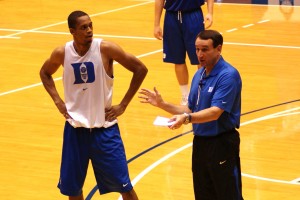
COACH K: ZONE OFFENSIVE POST POSITIONING

From clinic notes I have from Coach Krzyzewski.  He talks about the importance of keeping a post behind the zone…

  • stretches the zone
  • opens flash against the zone
  • gives post players great vision of the court
  • puts them in great offensive rebounding position